31 Oct – 7 Nov 2026 · private tour

Atlas, Sahara & the Imperial Citiesالمغرب · ⵍⵎⵖⵔⵉⴱ

A field guide to the eight days: what each stop is, why it matters, and the stories behind the mud kasbahs, the dunes and the medinas you'll be walking through.

Days
8
km by road
~1,700
Highest pass
2,260 m
UNESCO sites
6
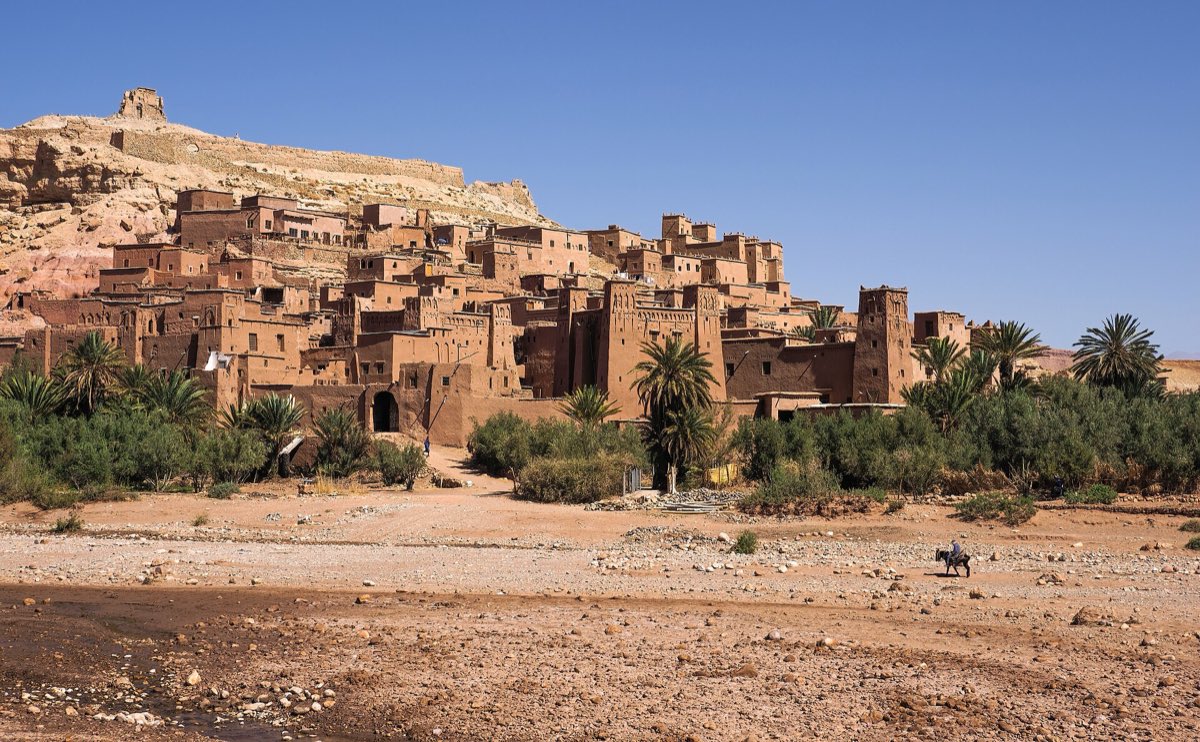
The earthen ksar of Aït Benhaddou climbing a hill above a river bed
Aït Benhaddou, Day 1
Before you go

Is it a good itinerary?

Yes. It's the classic Moroccan loop done in the right direction, with a private driver, a real night in the desert and a free buffer day in Merzouga. A few things to know:

  • Day 3 is the smartest part. Most tours rush straight out of the desert; you get a slow day there, which also absorbs fatigue from Day 2.
  • Day 2 is long: about 400 km with five stops and a sunset camel ride. Sunset in Merzouga is around 18:30, so expect an early start and short stops at Skoura and the Rose Valley.
  • Day 6 is the longest: Fes → Rabat → Casablanca → Marrakech is roughly 530 km. Ask the driver to aim for an afternoon Hassan II Mosque tour slot (it's a Thursday, so the normal schedule applies).
  • The roses won't be in bloom. The Rose Valley harvest is in May. In November you'll see the valley and the rose-water shops, not flowering fields.
  • Lake Dayet Srij may be dry. It only fills after rain. If it has water, look for flamingos.
  • 6 November is Green March Day, a national holiday. Expect flags everywhere and busier streets in Marrakech; the main sights normally stay open.
1
Saturday 31 October

Over the High Atlas to the gateway of the desert

Marrakech → Ouarzazate~200 km~4.5 h drivingNight: Ouarzazate
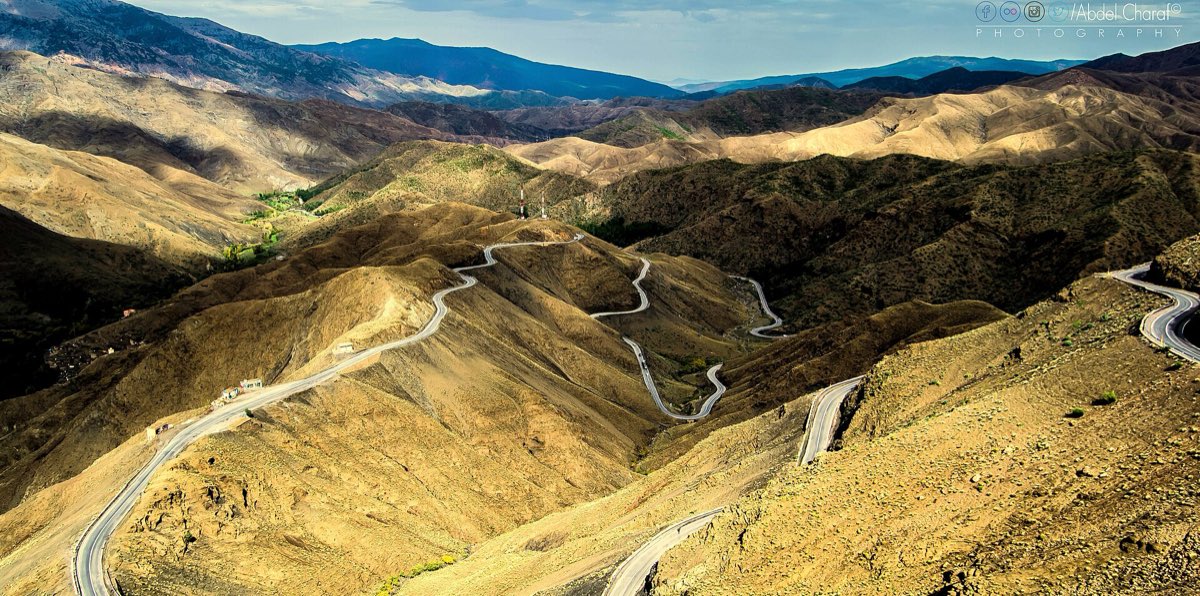
Hairpin road climbing the Tizi n'Tichka pass
Tizi n'Tichka

Tizi n'Tichka pass تيزي ن تيشكا

2,260 m · the N9 road

The highest major road pass in North Africa. "Tizi" is the Amazigh (Berber) word for a mountain pass. The road was built by the French army and opened in 1936, replacing a mule track that caravans had used for centuries to carry salt, dates and gold between the Sahara and Marrakech.

On the way up you pass Amazigh villages built from the same red earth as the slopes, walnut trees along the streams, and roadside stalls selling amethyst and quartz geodes.

  • Whoever held this pass controlled trade across the Atlas. In the early 1900s it was the Glaoui family, whose leader Thami El Glaoui became Pasha of Marrakech (1912–1956) and one of the richest men in the world. His abandoned kasbah at Telouet is just off the road.
  • The High Atlas runs about 800 km across Morocco. Jbel Toubkal (4,167 m), the highest peak in North Africa, is roughly 50 km west of the pass.
  • It can be 5–10 °C at the top even when Marrakech is warm. Keep a jacket in the car, and take motion-sickness tablets if you need them; there are a lot of hairpins.
Aït Benhaddou ksar at golden hour
Ksar Aït Benhaddou

Aït Benhaddou آيت بن حدو

UNESCO World Heritage since 1987

A ksar is a fortified village: a cluster of houses, a mosque, a caravanserai and a communal granary, all inside one defensive wall. Aït Benhaddou climbs a hill above the Ounila river on the old caravan route, and it is the best-preserved example in Morocco.

Everything is built from rammed earth (pisé) and mud brick mixed with straw. Earth walls need constant re-plastering after rain, so most of what you see dates from the 17th century onward, rebuilt in the old way. Only a handful of families still live inside; most moved to the new village across the river.

  • Film set favourite: Lawrence of Arabia, Jesus of Nazareth, The Mummy, Gladiator, Kingdom of Heaven and Game of Thrones (Yunkai and Pentos) were all shot here.
  • The building at the top of the hill is the agadir, the communal granary, which villagers retreated to under attack. The climb takes about 15 minutes and gives the best view.
  • You'll cross the river on stepping stones or a footbridge. Shops inside sell paintings made with saffron, tea and indigo that change colour when heated over a flame.
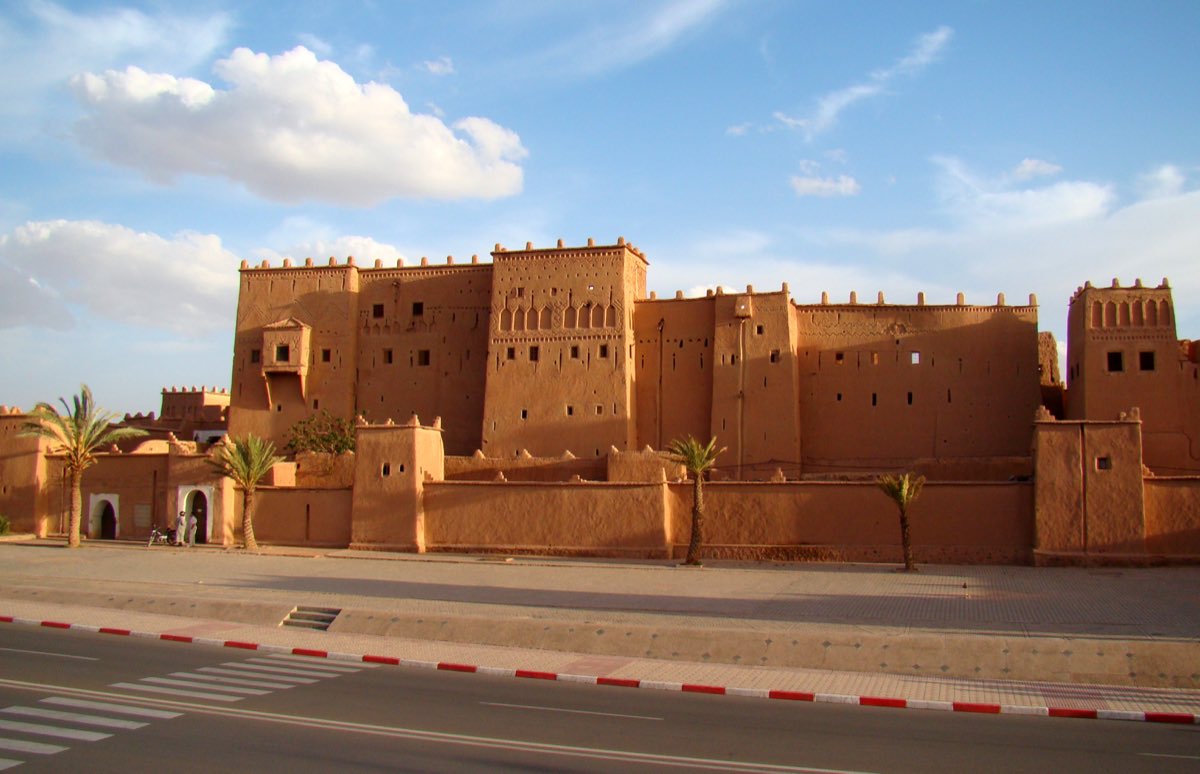
Kasbah Taourirt in Ouarzazate
Kasbah Taourirt, Ouarzazate

Ouarzazate ورزازات

"The door of the desert" · 1,160 m

The name is usually explained as Amazigh for "without noise". The French built the modern town in the 1920s as a garrison, around the older Kasbah Taourirt, a Glaoui family palace whose maze of rooms you can see from the road.

  • Atlas Studios (opened 1983) is one of the largest film studios in the world by area. Its lots still hold sets from Gladiator, Kundun and Asterix & Obelix: Mission Cleopatra.
  • Just outside town is Noor Ouarzazate, one of the largest concentrated solar power complexes on Earth (about 580 MW). Thousands of curved mirrors are visible from the air.
2
Sunday 1 November

The road of a thousand kasbahs, then the dunes

Ouarzazate → Merzouga~400 km~7 h driving + stopsNight: desert camp

The longest and most varied day: palm oasis, rose valley, two gorges, fossil country and the Sahara. Sunset at Erg Chebbi is around 18:30.

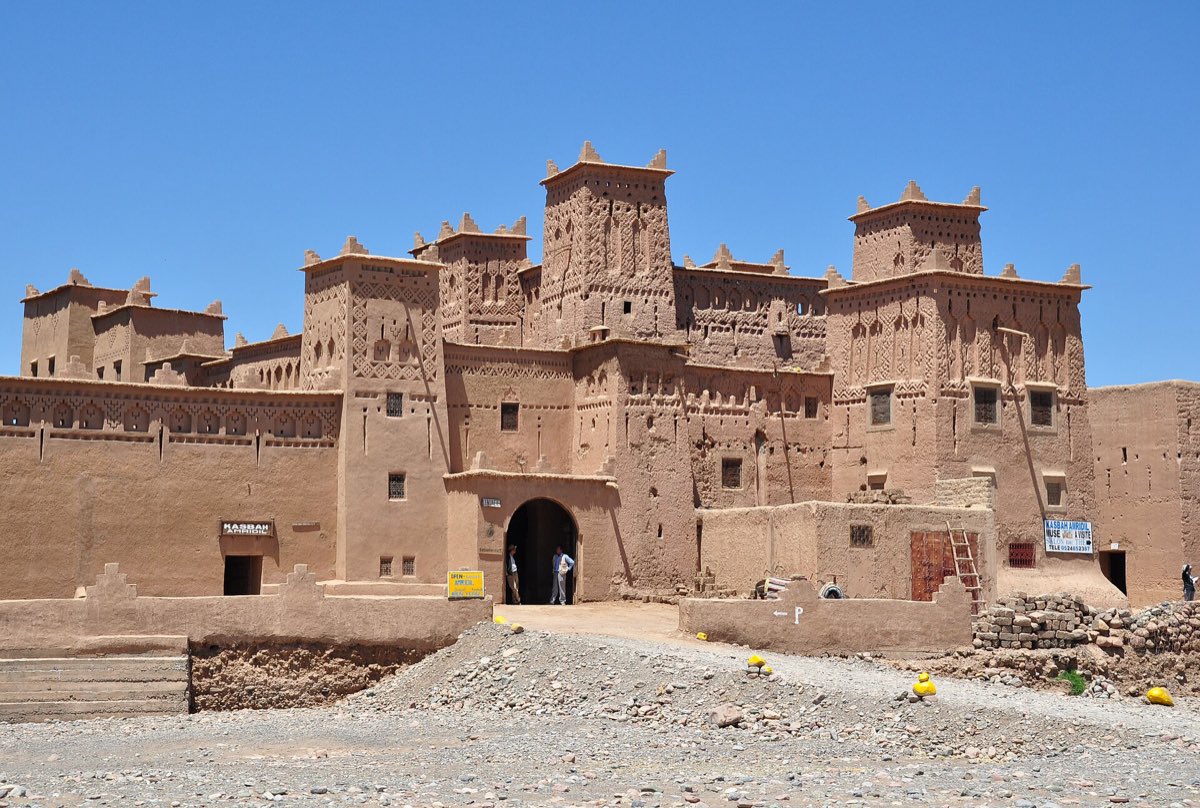
Kasbah Amridil with four corner towers
Kasbah Amridil, Skoura

Skoura oasis & Kasbah Amridil سكورة

17th-century family kasbah

Skoura is a palm grove of about 25 km² irrigated by khettaras, underground channels that bring water from the mountains without losing it to evaporation. Inside it stand dozens of kasbahs. A kasbah, unlike a ksar, is the fortified home of a single powerful family.

Amridil belongs to the same family that built it more than 300 years ago, and they still run it as a museum. Look for the olive press, the old kitchen tools and the decorated ceilings of palm and tamarisk wood.

  • Amridil was printed on the old 50-dirham banknote. Ask your guide; some shops still have one to show.

Valley of Roses · Kelaat M'Gouna قلعة مكونة

Rosa damascena country

The roses here are Damask roses, which local legend says pilgrims brought back from Damascus. They're grown as hedges between fields, not in plantations. In May the town holds a rose festival and the harvest is picked at dawn, when the scent is strongest.

  • It takes roughly 3–4 tonnes of petals to distil one litre of rose oil, which is why the pure oil is so expensive. Rose water is the affordable version and makes a good gift.
  • In November there are no blooms. Buy rose products at a cooperative rather than a roadside shop for the real thing.
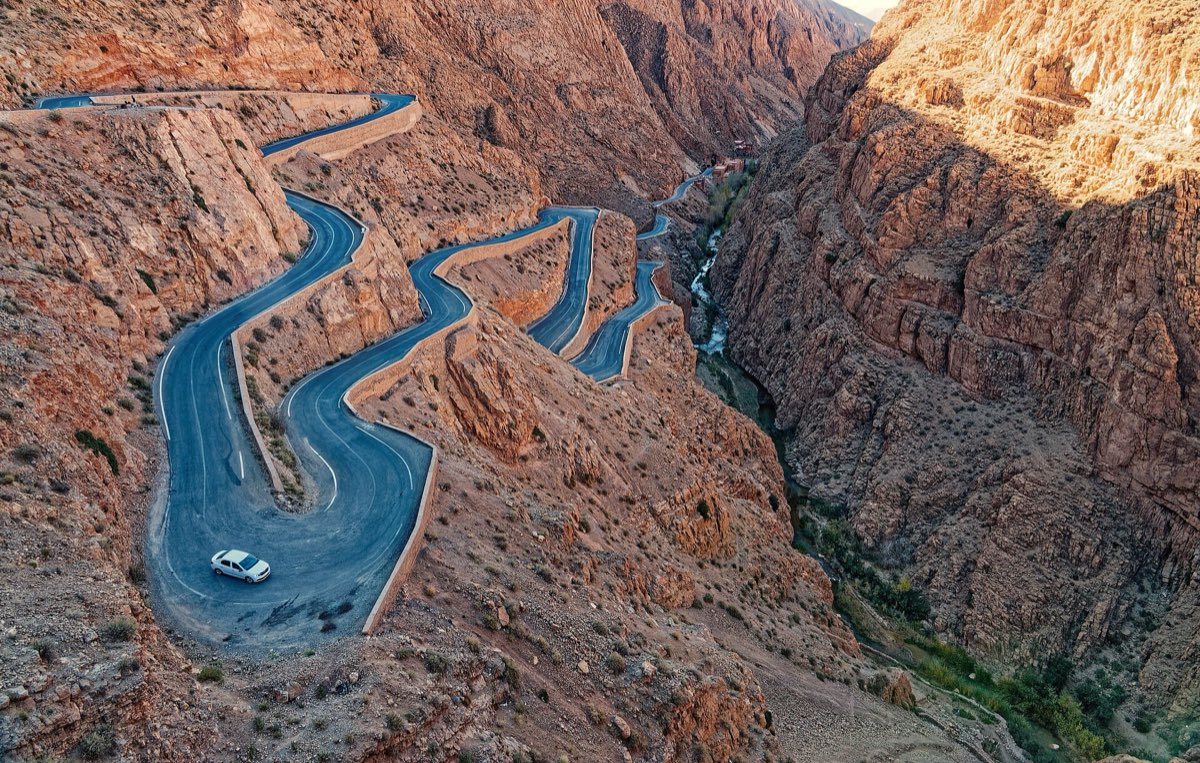
Hairpin bends of the Tissadrine road in the Dades gorge
Tissadrine hairpins, Dades

Dades Valley وادي دادس

Boumalne Dades

The Dades river cuts between the High Atlas and the volcanic Jbel Saghro, and the valley is lined with kasbahs, which is why the route east is called the Road of a Thousand Kasbahs. Higher up the valley, the rock is eroded into rounded red shapes locals call "monkey fingers".

  • The zig-zag road at Tissadrine (the photo) is one of the most photographed roads in Africa and regularly appears in car adverts.
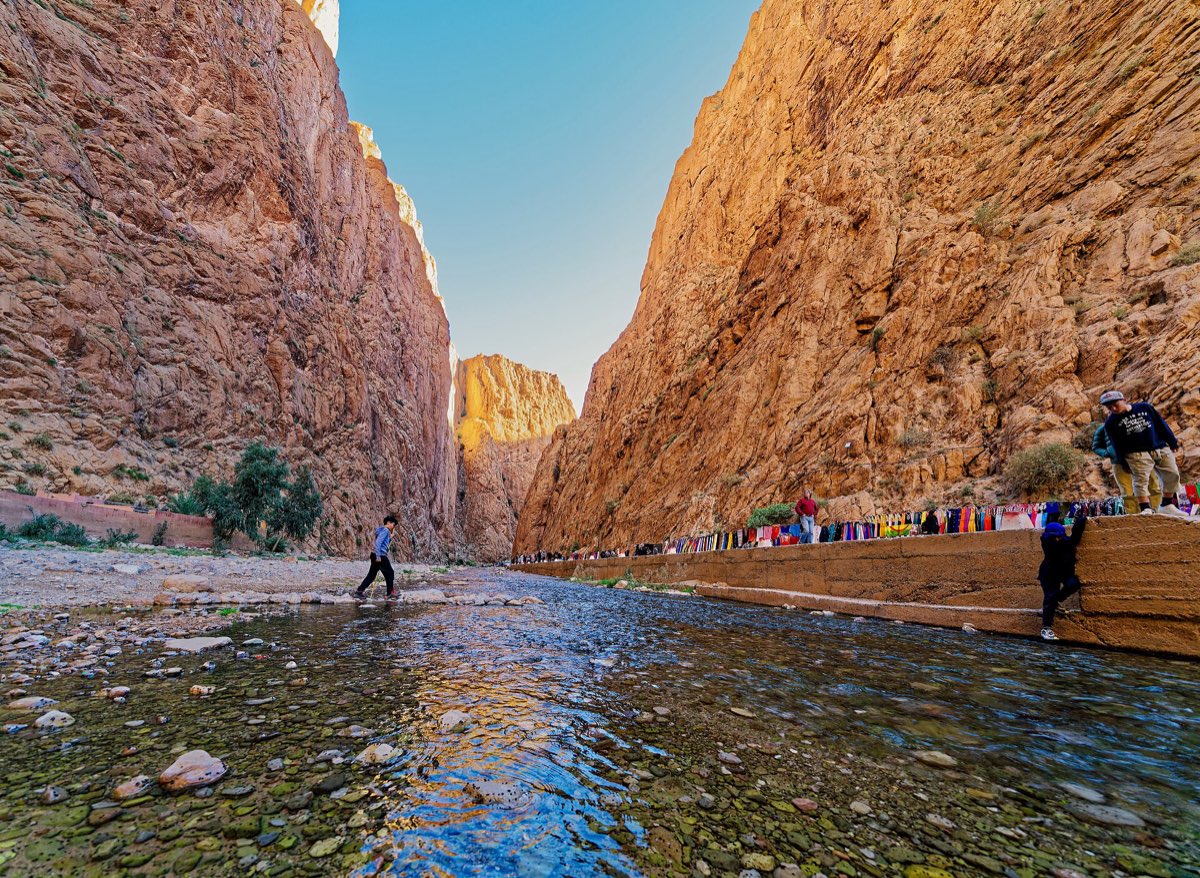
Shallow river between the sheer walls of the Todra gorge
Todra Gorge

Todra Gorge مضيق تودغى

Walls ~300 m high · ~10 m wide at the narrowest

The Todgha river has cut a slot through limestone just north of Tinghir. The last few hundred metres are the dramatic part: the walls rise straight up on both sides and the road runs right beside the stream, so you can walk it in 20 minutes.

  • The gorge is one of Morocco's main rock-climbing spots. Look up and you'll often see climbers on the walls.
  • The gorge floor gets sun only around midday; the rest of the time it's cool and shaded. Wade in the stream if you like; it's shallow.

Erfoud & the fossil workshops أرفود

Devonian seabed, ~350–400 million years old

This desert was once a shallow sea. The local black limestone is packed with fossils: straight cone-shaped orthoceras, spiral ammonites and trilobites. Workshops cut it into sinks, tabletops and polished slabs.

  • Many "perfect" trilobites sold to tourists are partly carved or assembled from fragments. Orthoceras slabs are the honest buy.
  • Near Erfoud lie the ruins of Sijilmasa, founded in 757. It was the northern terminus of the trans-Saharan gold trade, where caravans from Ghana and Mali arrived. The neighbouring Tafilalt oasis is where the current royal family, the Alaouites, came from in the 1600s.
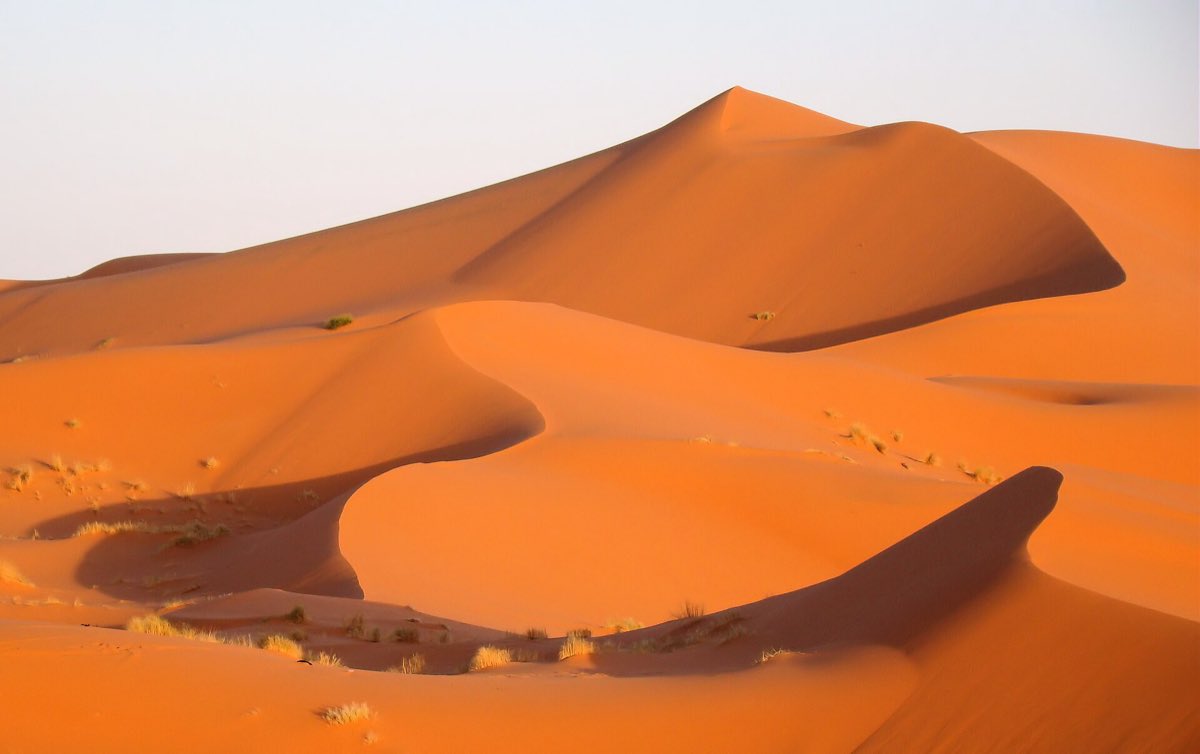
Orange dunes of Erg Chebbi
Erg Chebbi

Erg Chebbi & the camel ride عرق الشبي

Dunes up to ~150 m · ~22 km long

An erg is a sea of wind-blown sand dunes. Most of the Sahara is rock and gravel (hamada), so ergs like this one are the exception, and Erg Chebbi is the largest in Morocco. The dunes turn orange to red at sunset because of iron oxide coating the sand grains.

  • Local legend says the dunes were sent by God to bury a wealthy family who turned away a poor woman and her son.
  • Moroccan camels are dromedaries (one hump). They can drink around 100 litres in ten minutes.
  • Desert nights in November drop to 5–8 °C. Bring a warm layer to the camp. Wake up for sunrise around 07:30; it's often better than the sunset. Look up after dinner: with no light pollution, the Milky Way is clearly visible.
3
Monday 2 November

Beyond the dunes: nomads, oases and Gnawa music

4×4 loop around Merzougaoff-roadNight: hotel by the dunes
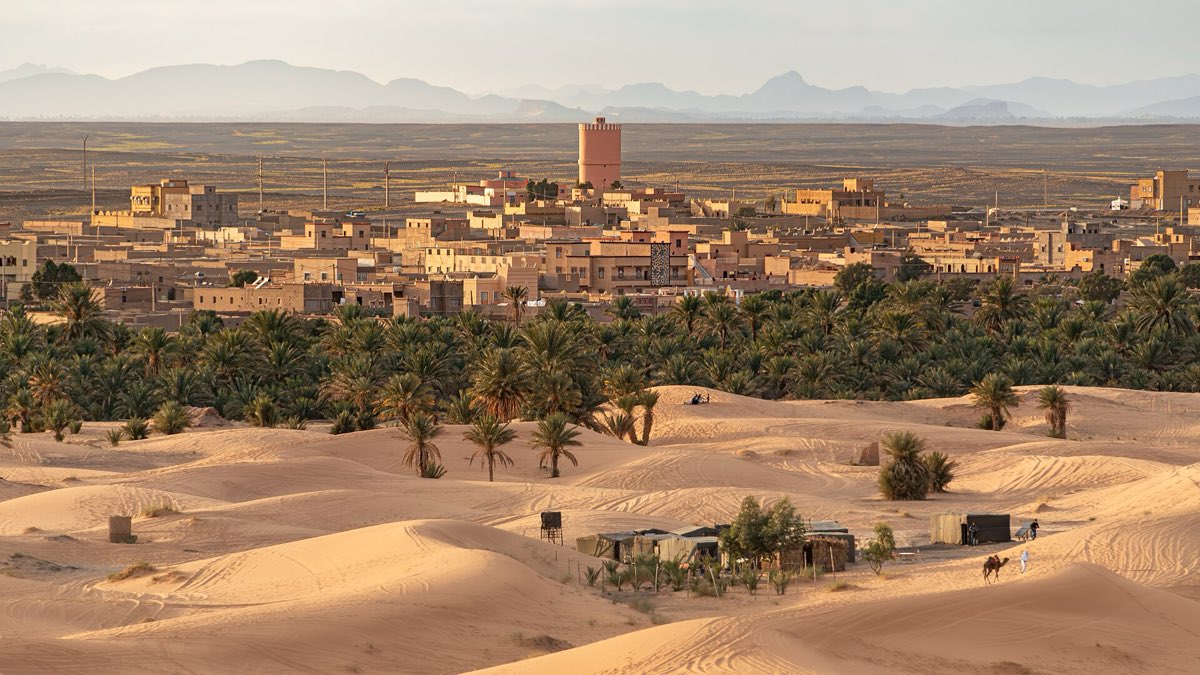
Merzouga village with palm grove, dunes in front
Merzouga and its palm grove

Nomad families & Lake Dayet Srij

Amazigh herding families · seasonal lake

The families around Erg Chebbi are mostly from the Aït Khebbach, part of the Aït Atta confederation, Amazigh herders who once controlled these caravan routes. Some still live in wool or canvas tents and move with their goats and camels between water points.

Dayet Srij is a lake that only exists after rain. When it holds water, flamingos and other migrating birds stop here, which looks unreal against the dunes.

  • Mint tea is poured from high up to aerate it and make foam. A saying often repeated in the desert: the first glass is gentle like life, the second strong like love, the third bitter like death.
  • Ask before photographing people. A small gift (sugar, tea) or a few dirhams for the family is appreciated; your guide will tell you what's normal.
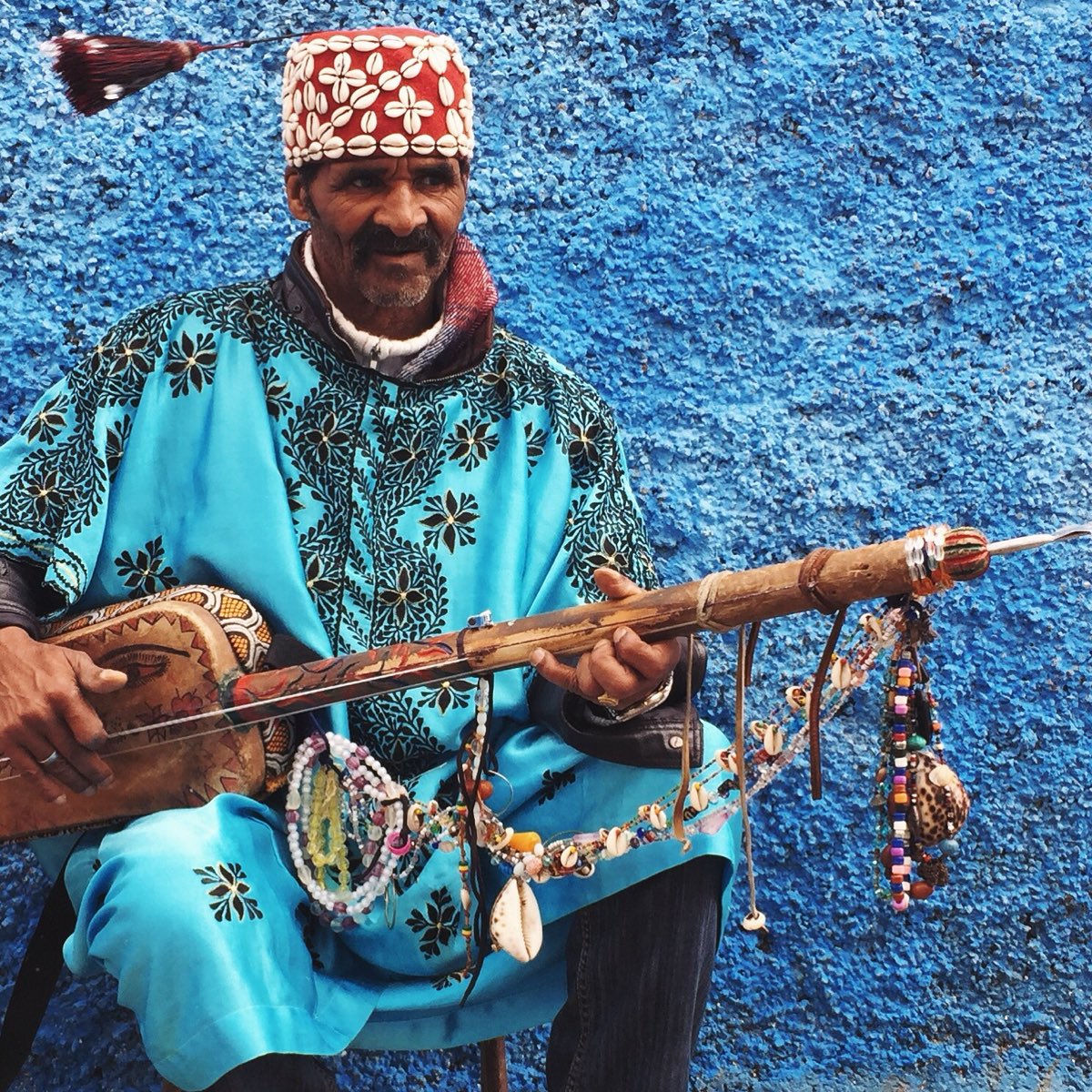
Gnawa musician in blue robe playing a guembri
Gnawa musician with a guembri

Khamlia & Gnawa music خملية · كناوة

UNESCO Intangible Heritage since 2019

Khamlia is a village of Gnawa people, descendants of West Africans brought north across the Sahara, many of them enslaved, in the caravan trade. Their music mixes African rhythm with Sufi spiritual practice and was traditionally used in all-night healing ceremonies.

  • Listen for the guembri (a three-string bass lute covered in camel skin) and the qraqeb, heavy iron castanets that make the hypnotic clacking sound.
  • Gnawa music has crossed into rock and jazz: Jimmy Page and Robert Plant recorded with Gnawa musicians in Marrakech in 1994, jazz players like Randy Weston worked with them for decades, and Essaouira hosts a big Gnawa festival every summer.
4
Tuesday 3 November

Desert to cedar forest in one day

Merzouga → Fes~470 km~8 h drivingNight: Fes

You'll climb from about 750 m at the edge of the Sahara to over 2,000 m in the Middle Atlas. Watch the landscape change from dunes to palm valleys to bare plateau to cedar forest.

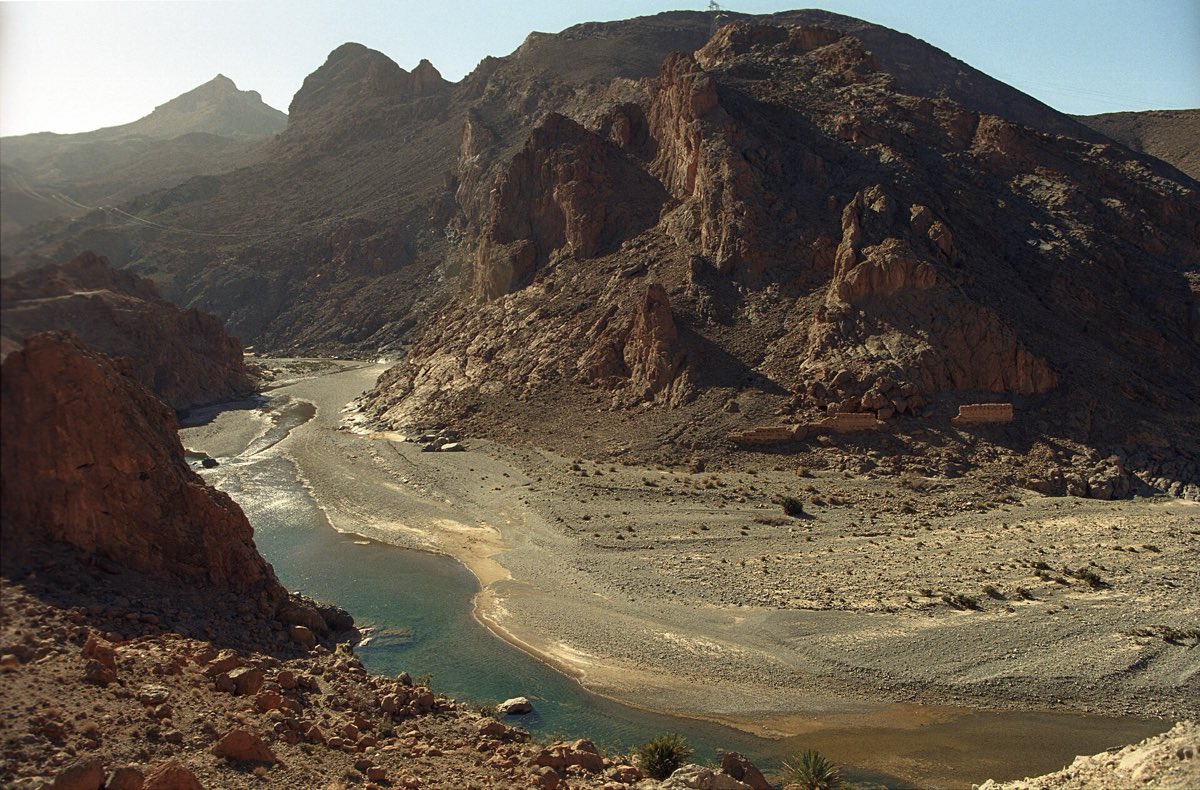
The Ziz river winding through a rocky canyon
Ziz gorges

Ziz Valley وادي زيز

Tafilalt palm groves · Errachidia

The Ziz river flows south from the Atlas to feed the Tafilalt, one of the largest date-palm oases in the world. From the viewpoints you see a green ribbon of palms in a brown canyon, with mud villages along the edge.

  • The Medjool (majhoul) date, now grown in California and Israel, originated in the Tafilalt. In the 1920s a few offshoots were taken to the US to save the variety from a palm disease.
  • North of Errachidia the road passes through the "Legionnaires' Tunnel", cut through the rock by the French Foreign Legion in 1927–28.

Midelt ميدلت

~1,500 m · lunch stop

A plateau town between the High and Middle Atlas, overlooked by Jbel Ayachi (3,737 m), often snow-capped from November. Midelt is Morocco's apple capital and holds an apple festival every autumn; you'll see orchards and stalls along the road.

  • The area was a major mining centre for lead and is famous among collectors for its vanadinite crystals, bright red minerals sold in roadside shops.
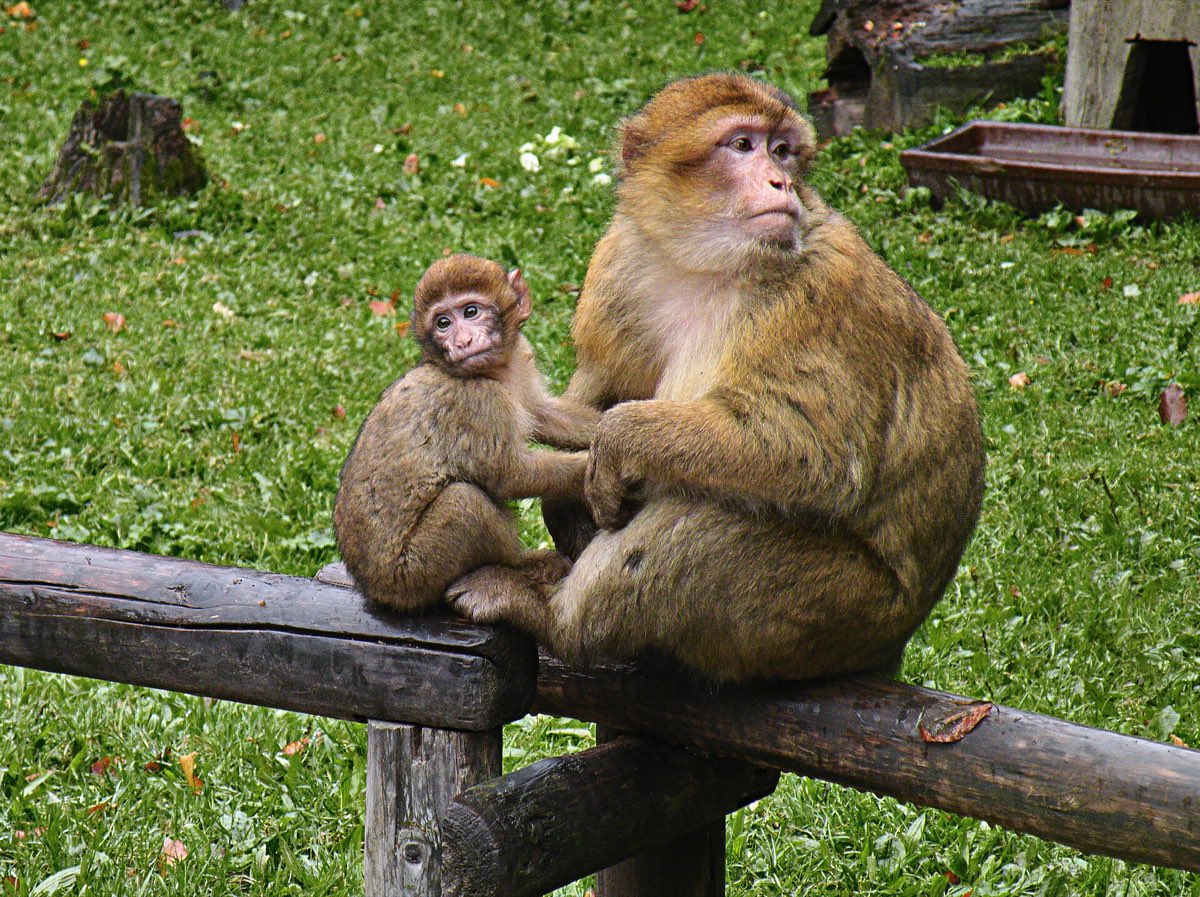
Barbary macaque mother holding her baby
Barbary macaques

Azrou cedar forest أزرو

Atlas cedars · Barbary macaques

"Azrou" means "rock" in Tamazight. Around the town grows one of the largest Atlas cedar forests left. Some trees are several hundred years old, and their wood is the fragrant cedar used in the carved ceilings you'll see in Fes and Marrakech.

  • The Barbary macaque is the only primate in Africa north of the Sahara, and the only macaque outside Asia. The famous Gibraltar monkeys are the same species. It's endangered: fewer than 10,000 remain in the wild.
  • Don't feed them, even if others do. Food from tourists makes them sick and aggressive.

Ifrane إفران

"Switzerland of Morocco" · 1,665 m

The French built Ifrane in 1929 as a cool summer retreat, with Alpine-style houses and steep red roofs designed to shed snow. It's now one of the cleanest towns in the country and has a ski slope nearby in winter.

  • In 1935 Ifrane recorded −23.9 °C, still the lowest temperature ever measured in Africa.
  • The stone lion in the town park is the obligatory photo stop. It's usually said to have been carved by an Italian prisoner of war during WWII.
5
Wednesday 4 November

Fes, the medieval city that is still lived in

Guided walk in the medinaon footNight: Fes

Fes el-Bali (UNESCO, 1981) is often called the largest car-free urban area in the world. Goods are still moved by donkey and handcart through about 9,000 alleys. Founded in 789, it was Morocco's capital several times and its religious and intellectual centre for a thousand years.

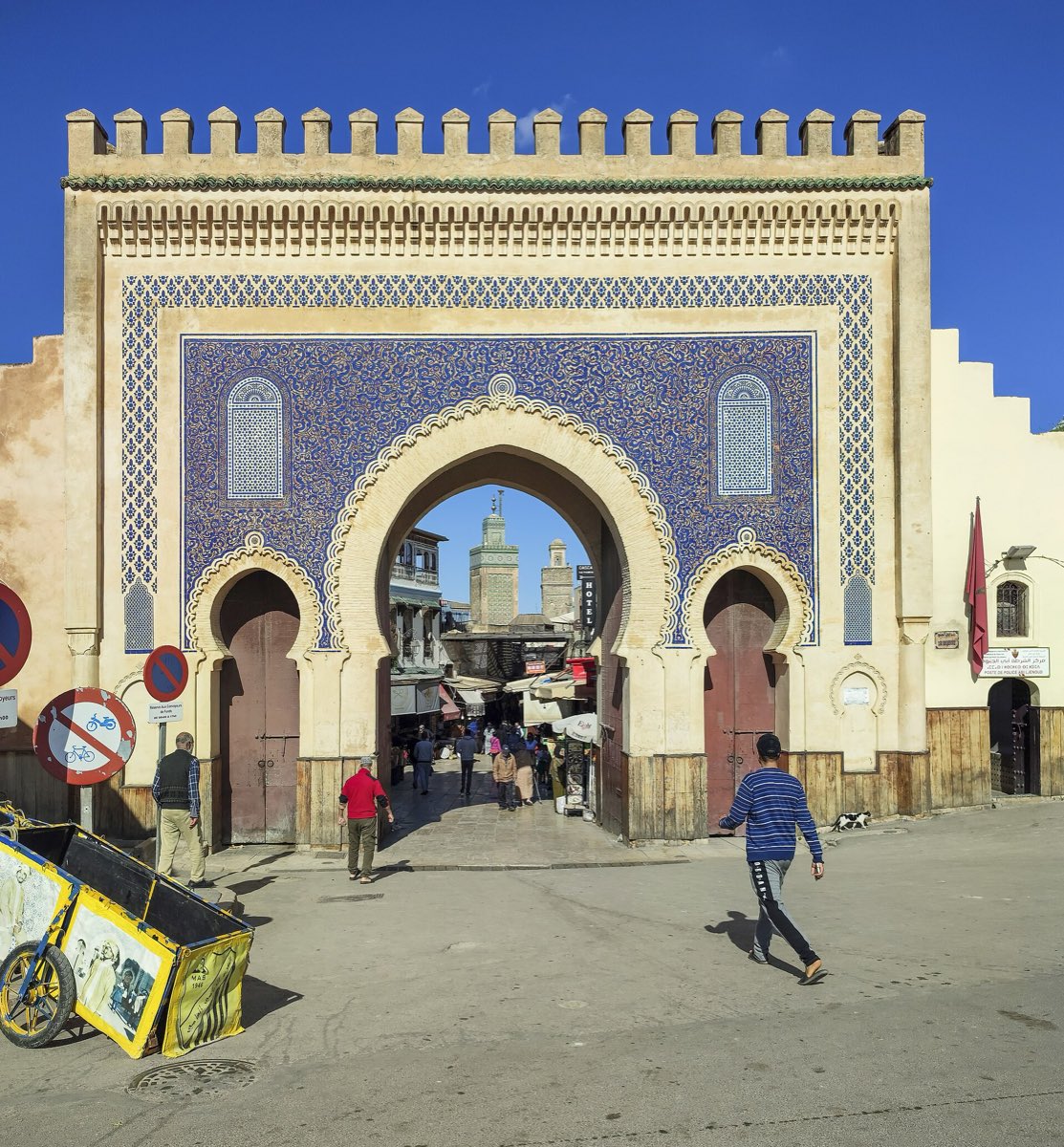
Bab Bou Jeloud gate covered in blue tiles
Bab Bou Jeloud, the Blue Gate

Bab Bou Jeloud باب بوجلود

Main entrance to the old medina · 1913

Most walks start at the Blue Gate. It's blue on the outside, the colour of Fes, and green on the inside, the colour of Islam. Through its arches you can already see two minarets.

  • Fes was founded by Idris I in 789 and expanded by his son Idris II in 808. Idris II's tomb is in the medina and is one of the holiest places in Morocco.
  • The fez hat is named after the city, which was the centre of its trade, and the red dye originally came from local berries.
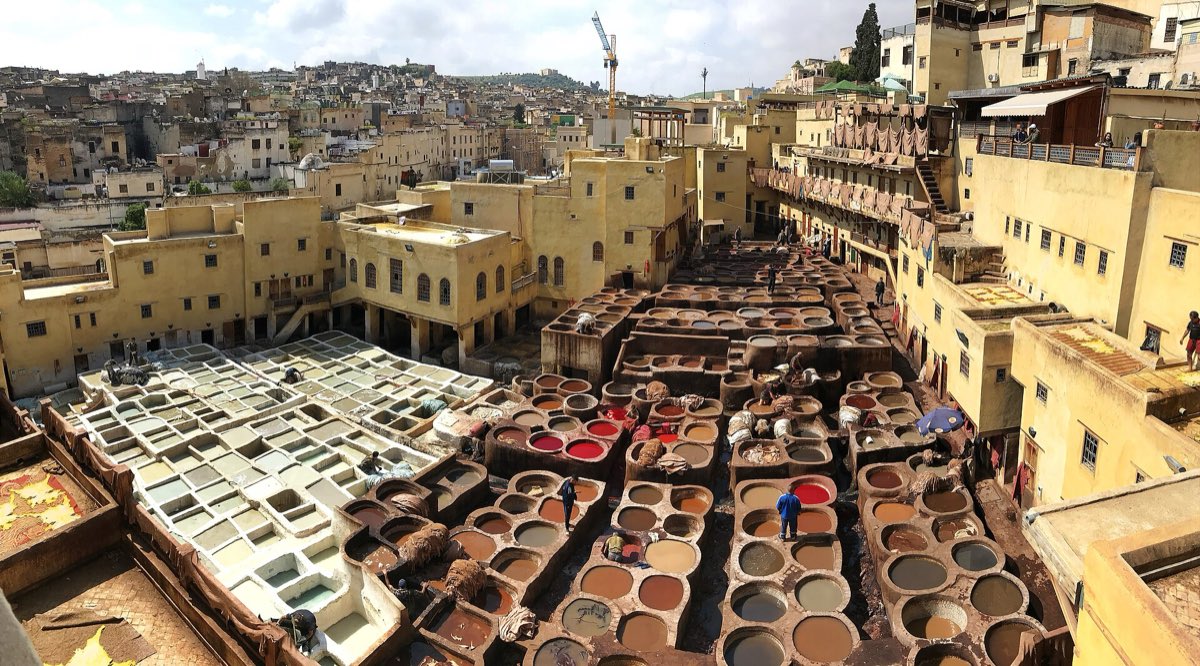
Stone vats of colourful dye at the Chouara tannery
Chouara Tannery

Chouara Tannery دار الدباغ شوارة

In use since around the 11th century

The honeycomb of stone vats is worked the medieval way. Hides are first soaked in white vats of quicklime, salt, cow urine and pigeon droppings, whose ammonia softens the leather. Then they go into the coloured vats to be dyed by hand, often with men standing waist-deep.

  • Traditional dyes: poppy for red, indigo for blue, henna for orange, saffron or pomegranate for yellow, and mint for green.
  • You view it from the terraces of the leather shops around it. They'll hand you a sprig of mint to hold under your nose. Morning light is best. Bargaining starts at about a third of the first price.
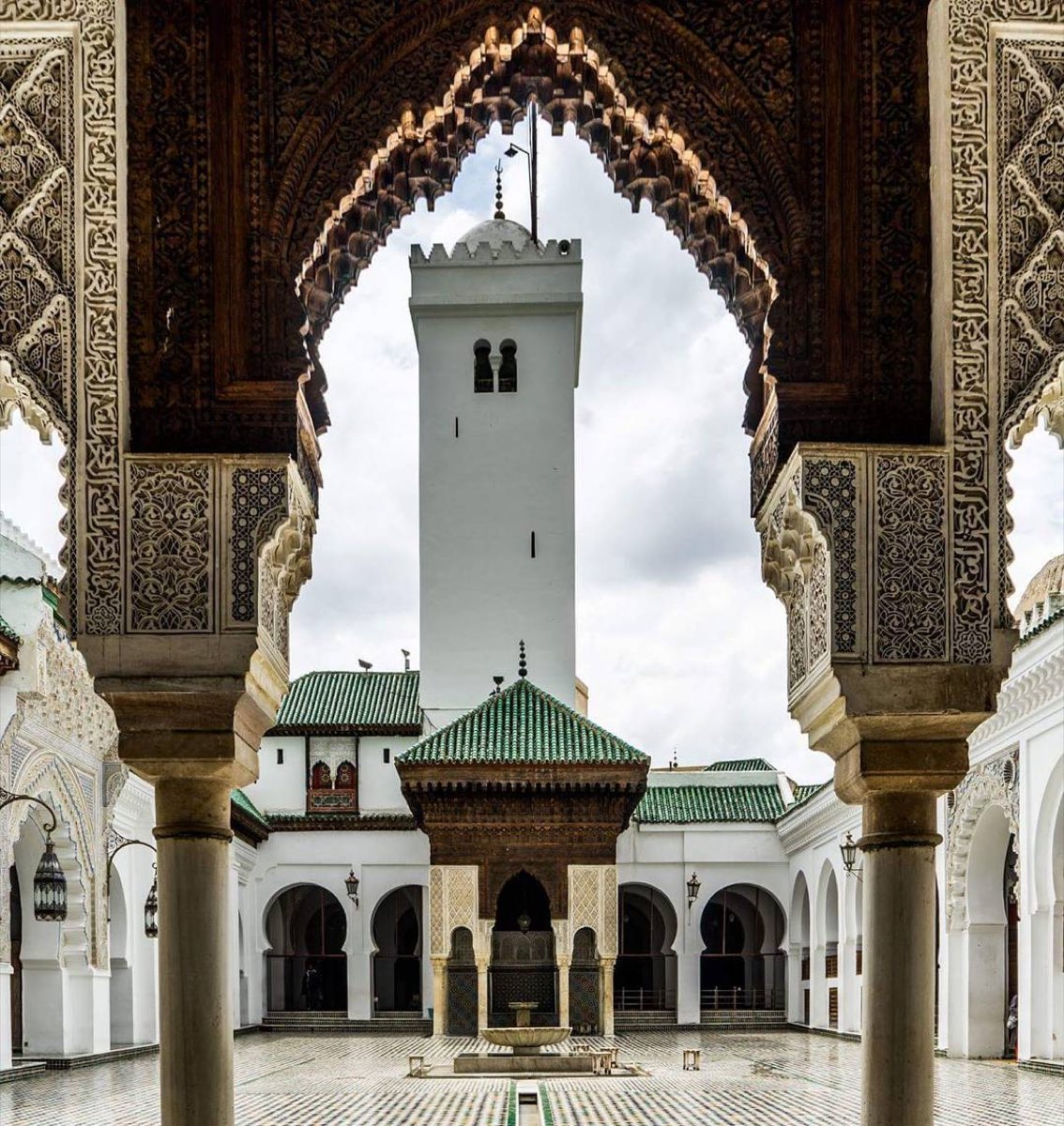
Courtyard of the al-Qarawiyyin mosque with green tiled roofs
Al-Qarawiyyin

Al-Qarawiyyin جامعة القرويين

Founded 859

Founded by Fatima al-Fihri, the daughter of a wealthy merchant from Kairouan, Al-Qarawiyyin is recognised by UNESCO and Guinness as the oldest continuously operating university in the world. Its library, one of the oldest in the world, holds a 9th-century Quran and manuscripts by Ibn Khaldun.

  • Scholars who studied or taught here include the philosopher Ibn Rushd (Averroes), the historian Ibn Khaldun and the Jewish thinker Maimonides. Legend also links it to Pope Sylvester II, who is said to have helped bring Arabic numerals to Europe.
  • Non-Muslims can't enter the mosque, but you can look into the courtyard through the open doors.
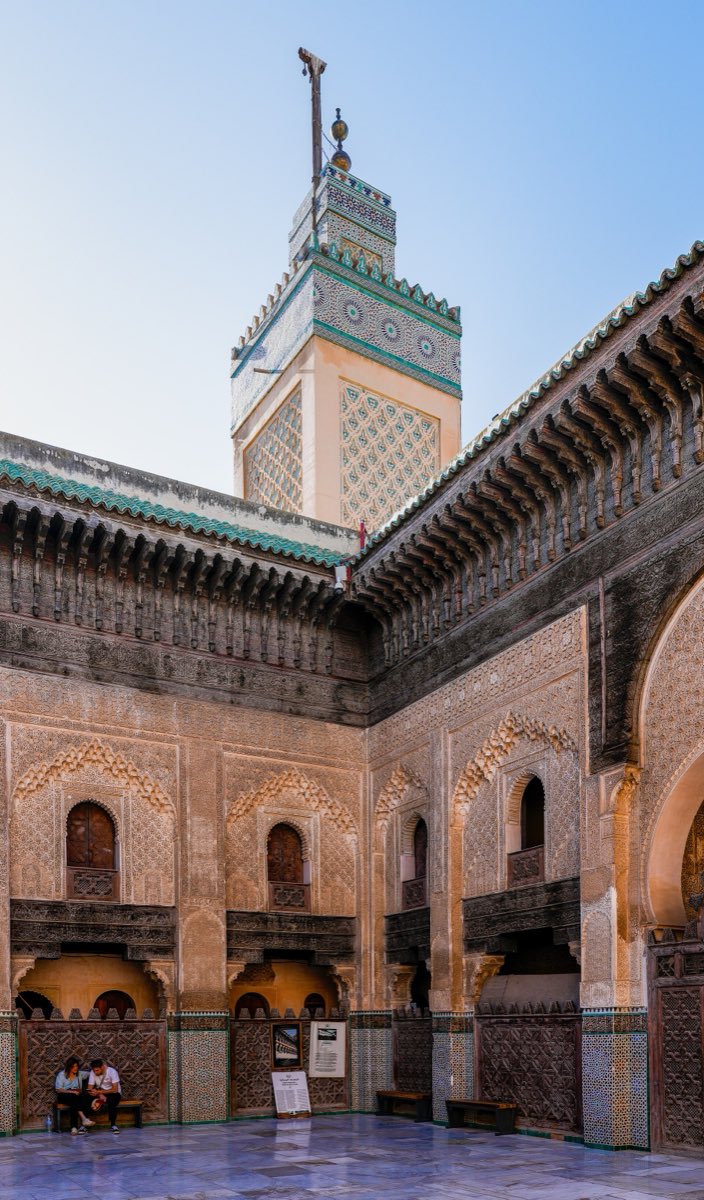
Carved stucco courtyard and minaret of the Bou Inania madrasa
Bou Inania Madrasa

The madrasas: Bou Inania & Al-Attarine

Marinid dynasty · 1323–1355

A madrasa was a boarding college where students lived in small cells around a courtyard while studying at Al-Qarawiyyin. The Marinid sultans built them as showpieces. Every surface is decorated: zellige tile at the bottom, carved stucco in the middle and carved cedar at the top. It's a three-layer formula you'll start spotting everywhere.

  • Bou Inania (1350–55) is one of the few religious buildings in Morocco open to non-Muslims. Opposite it are the remains of a 14th-century water clock with 13 bronze bowls. Nobody fully knows how it worked.
  • Zellige is cut by hand from glazed tiles into hundreds of small shapes, then assembled face-down like a puzzle. A master learns several hundred shapes by heart.
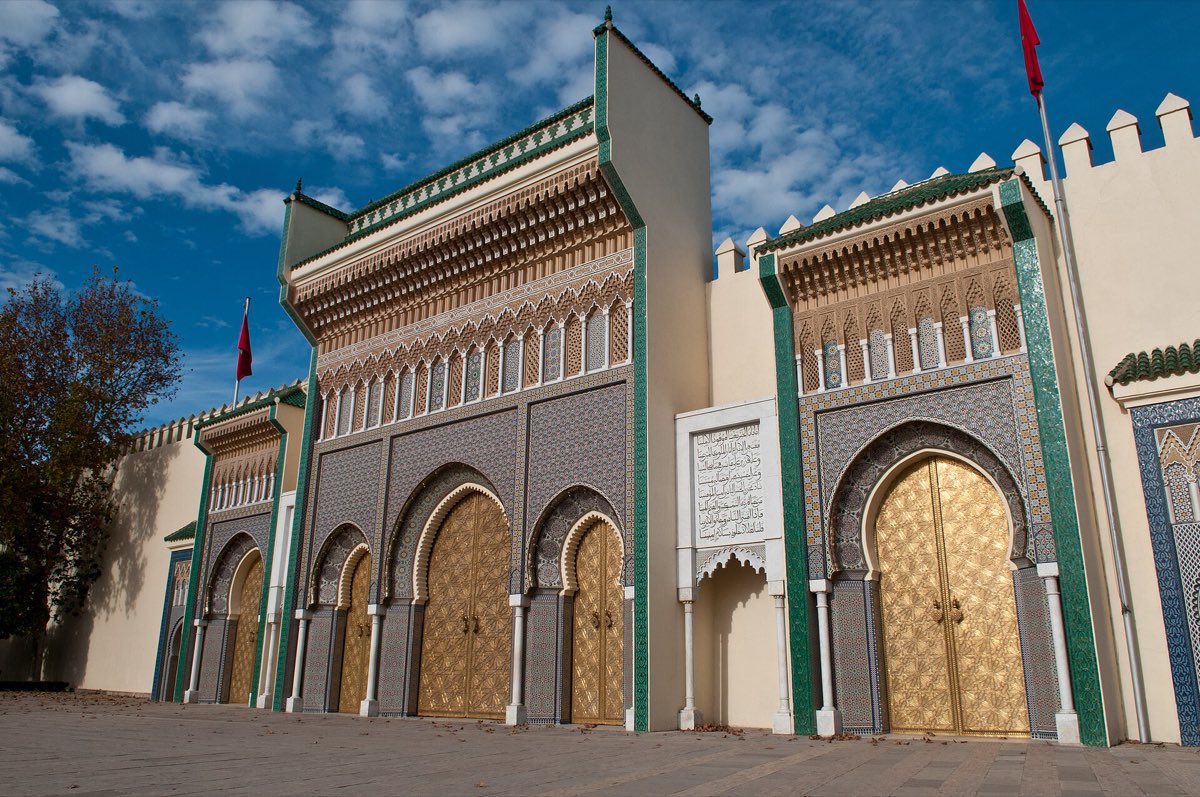
Golden brass doors of the Royal Palace in Fes
Dar al-Makhzen, Fes

Royal Palace gates دار المخزن

Fes el-Jdid

The palace itself is closed to visitors, but its seven gilded brass doors, framed by zellige and carved cedar, are one of the best photo spots in Fes. Fes el-Jdid ("New Fes") was built by the Marinids in 1276. Next to it is the Mellah, the old Jewish quarter, recognisable by its wooden balconies facing the street.

6
Thursday 5 November

The Atlantic capitals

Fes → Rabat → Casablanca → Marrakech~530 km~6.5 h drivingNight: Marrakech
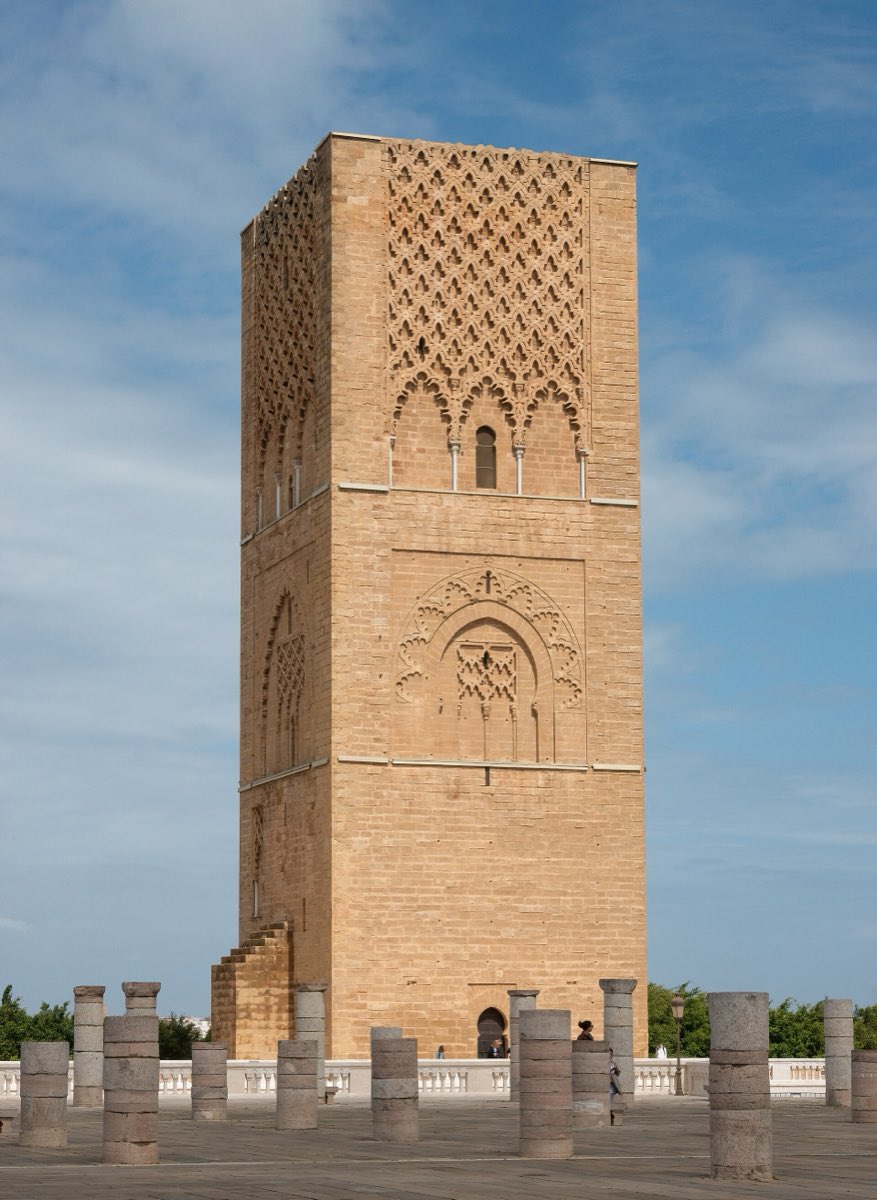
The unfinished Hassan Tower with rows of column stumps
Hassan Tower, Rabat

Hassan Tower صومعة حسان

Begun 1195 · never finished

The Almohad caliph Yaqub al-Mansur set out to build the largest mosque in the world here. When he died in 1199, construction stopped. The minaret reached 44 m of a planned 60-plus, and the 1755 Lisbon earthquake brought down the rest. The rows of column stumps show how vast the prayer hall would have been.

  • The same caliph built the Koutoubia in Marrakech (Day 7) and the Giralda in Seville. You'll have seen two of the three sisters by the end of the trip.
  • Instead of stairs, the tower has a ramp inside, so the muezzin could ride up on horseback.
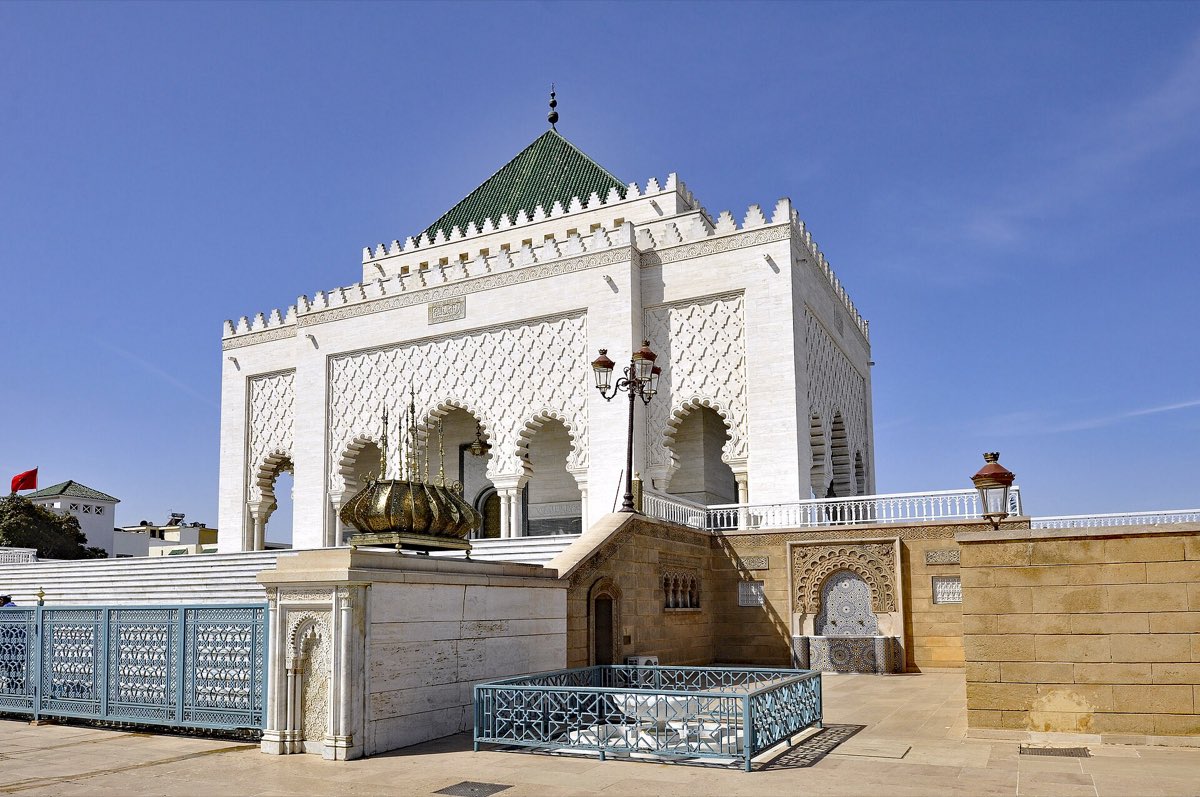
The white Mausoleum of Mohammed V with a green tiled roof
Mausoleum of Mohammed V

Mausoleum of Mohammed V ضريح محمد الخامس

Completed 1971

Across the esplanade from the tower lie Mohammed V, the king who led Morocco to independence from France in 1956, and his sons Hassan II and Prince Abdallah. It was designed by the Vietnamese architect Eric Vo Toan. Inside, the ceiling is carved cedar covered in gold leaf.

  • Royal guards in red and white uniforms stand at the gates, some of them on horseback. You can photograph them; they won't move.
  • Rabat became the capital only in 1912, when the French protectorate moved government away from the old imperial cities of Fes and Marrakech.
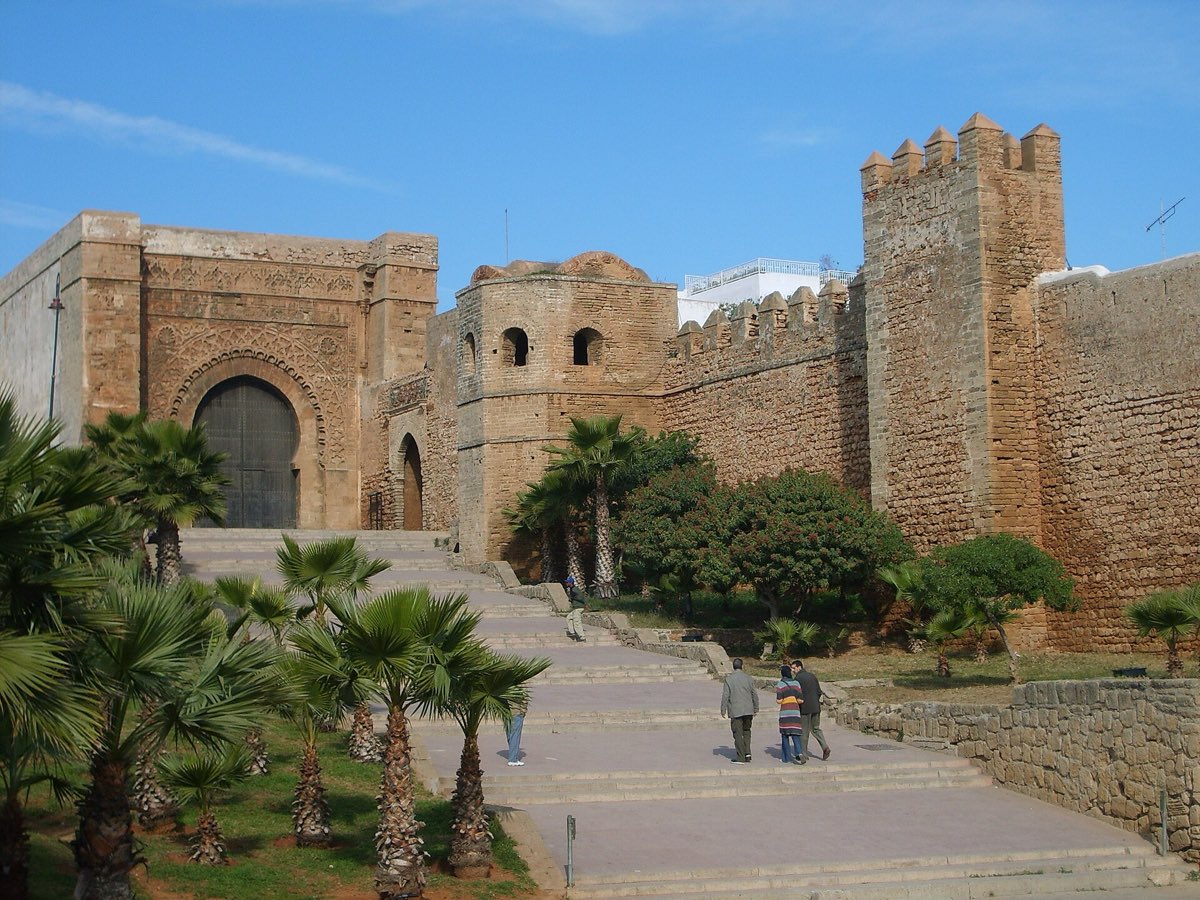
Walls and gate of the Kasbah of the Udayas
Kasbah of the Udayas

Kasbah of the Udayas قصبة الأوداية

12th century · at the mouth of the Bou Regreg river

A fortress built by the Almohads on a cliff above the ocean. Behind the monumental gate is a quiet neighbourhood of whitewashed houses with the lower half painted blue, a café with views over the river to Salé, and a walled Andalusian garden.

  • In the 1600s Rabat and Salé formed the "Republic of Bou Regreg", a pirate state whose corsairs raided as far as Iceland and Ireland.
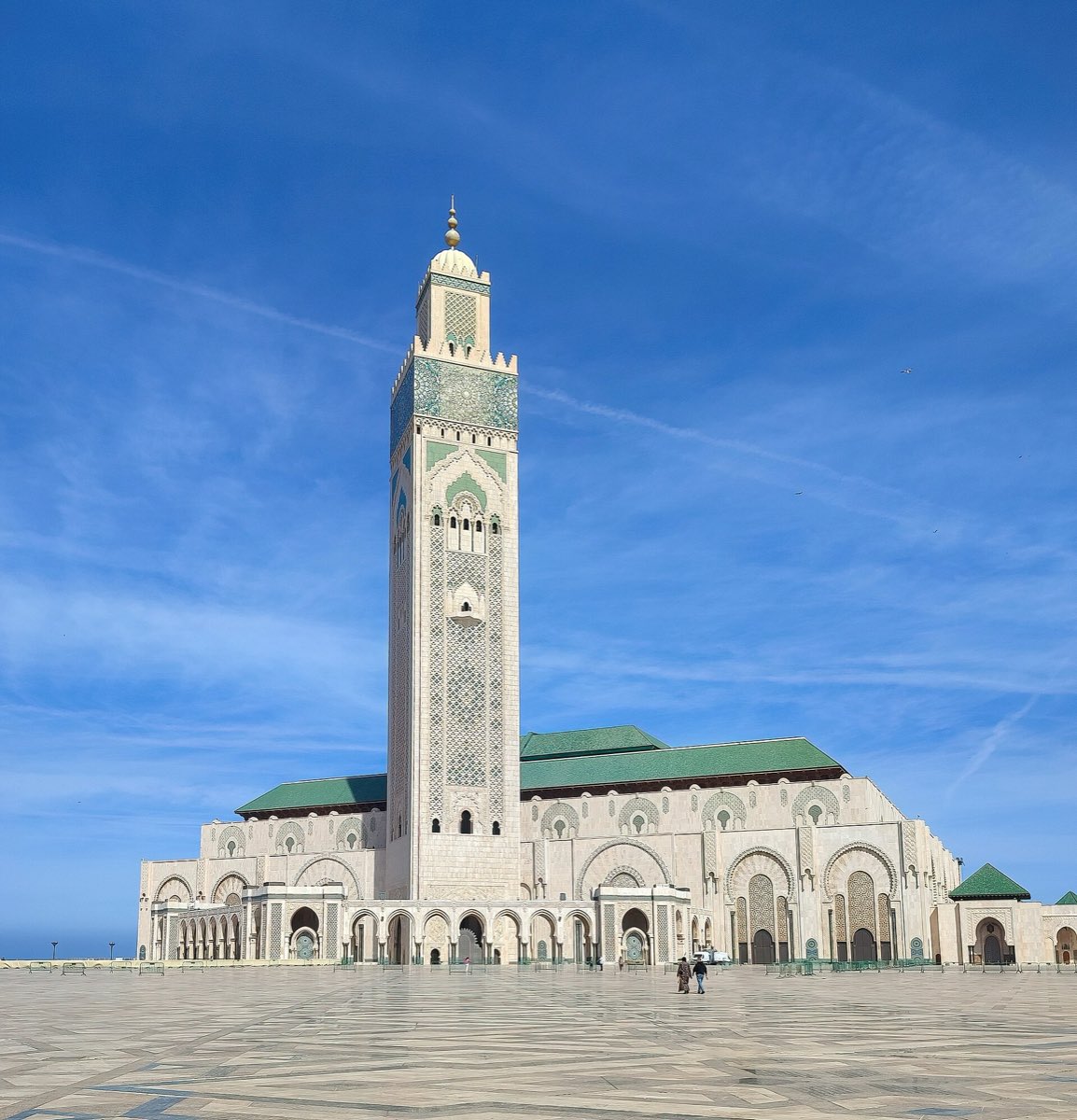
Hassan II Mosque with its tall minaret by the ocean
Hassan II Mosque, Casablanca

Hassan II Mosque مسجد الحسن الثاني

Completed 1993 · minaret 210 m

Built partly on a platform over the Atlantic, following the Quran verse that "the throne of God was upon the water". It took around 10,000 craftsmen about seven years. The prayer hall holds 25,000 people, the esplanade another 80,000, and the roof can slide open in a few minutes.

  • Its minaret was the tallest in the world until 2019 (now second, after Algiers). At night a laser beam from the top points toward Mecca.
  • It's one of the very few mosques in Morocco that non-Muslims can enter, on a guided tour.
  • Cover shoulders and knees. You'll take your shoes off and carry them in a bag. The film Casablanca (1942) was shot entirely in Hollywood; the "Rick's Café" in town was only created in 2004.
7
Friday 6 November · Green March Day

Marrakech, the red city

Guided walk + free afternoonon footNight: Marrakech

Founded around 1070 by the Almoravids, Marrakech gave the whole country its name in many languages: Marruecos, Maroc, Morocco. The medina walls run for about 19 km and are built of the same ochre earth that gives it its nickname.

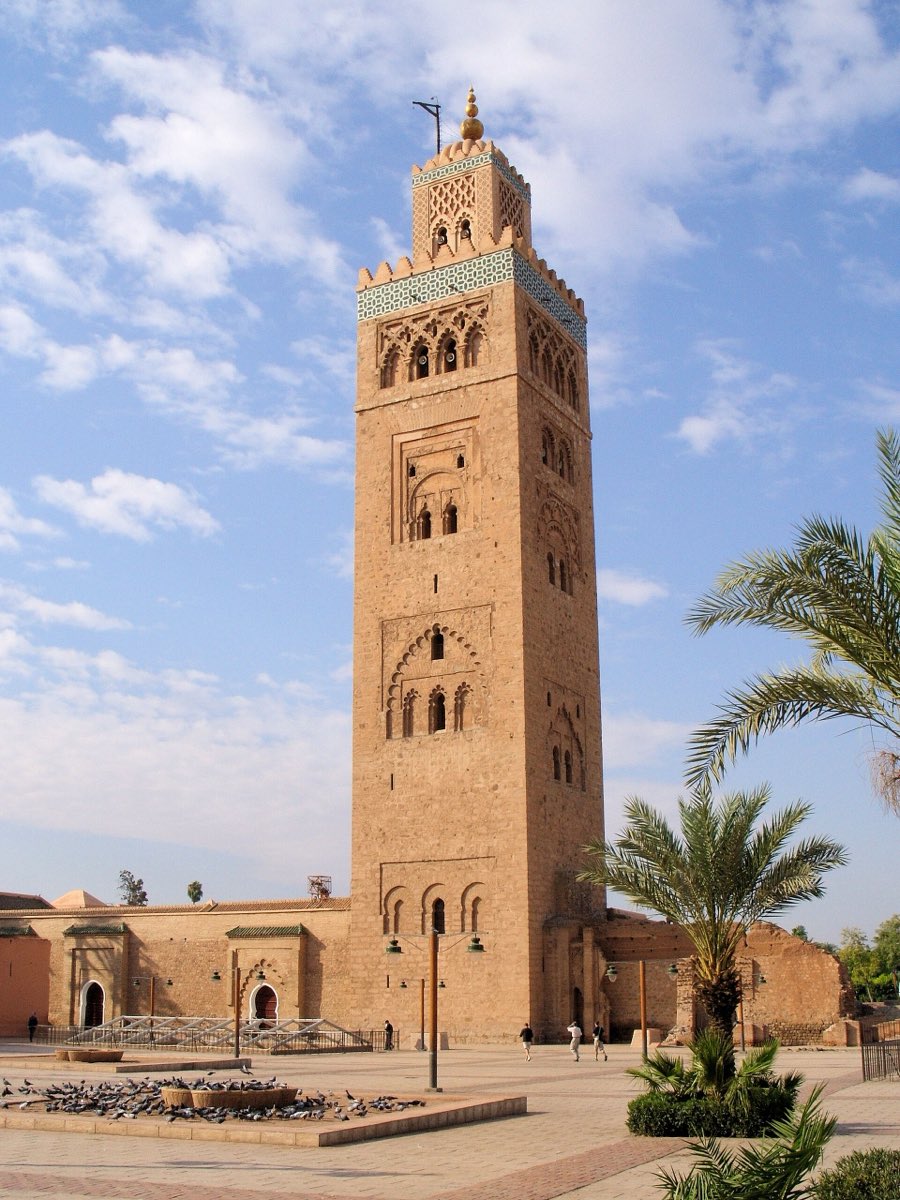
The Koutoubia minaret at sunset
Koutoubia Mosque

Koutoubia Mosque جامع الكتبية

Minaret 77 m · 12th century

The name means "mosque of the booksellers", after the manuscript sellers who once crowded around it. Each face of the minaret is decorated differently, and by city tradition no building in the medina may be taller.

  • The first mosque on the site turned out to be misaligned with Mecca, so the Almohads built a second one right next to it. You can see the foundations of the first beside the current one.
  • Friday is the main prayer day, so it's especially busy around midday. It's at its best at golden hour from the gardens.
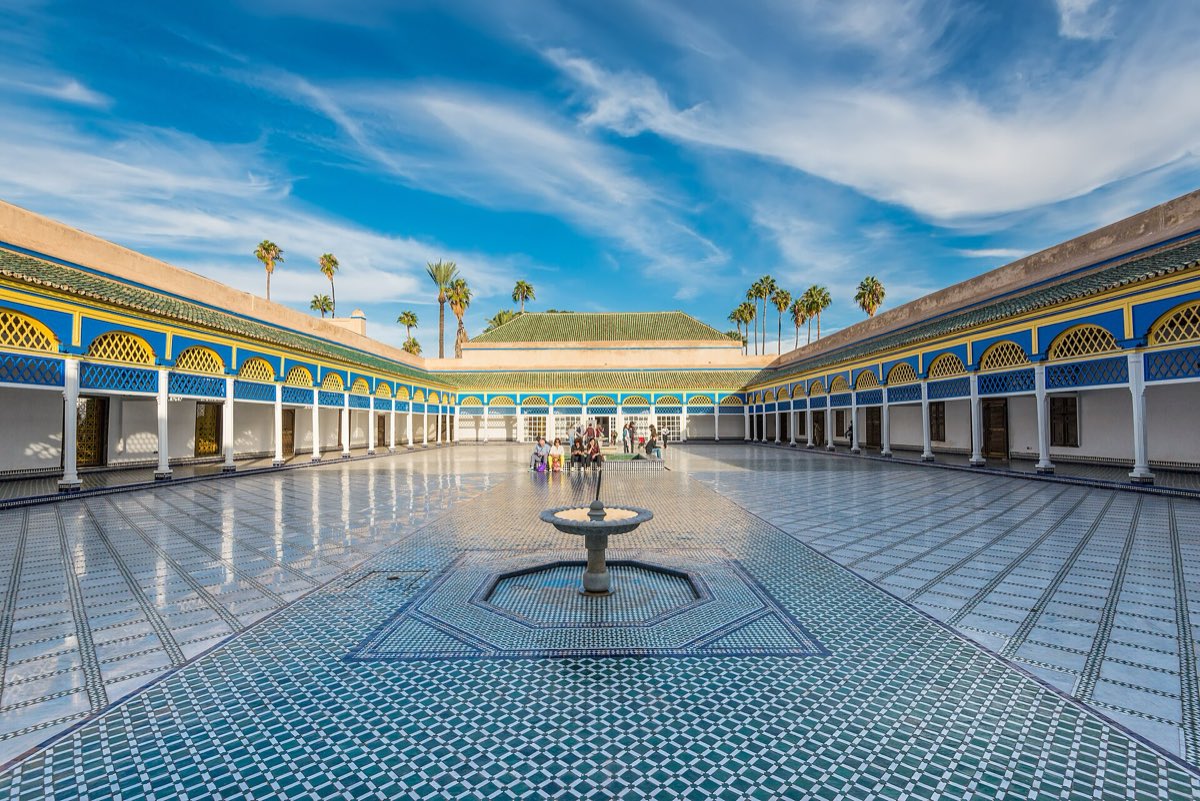
Large marble courtyard of the Bahia Palace
Bahia Palace, great courtyard

Bahia Palace قصر الباهية

Late 19th century · "the brilliant"

Built by two grand viziers, Si Moussa and then his son Ba Ahmed, who was effectively ruling Morocco for the boy sultan Abdelaziz. It spreads over about 8 hectares of courtyards, gardens and painted cedar ceilings. Ba Ahmed kept adding rooms as he bought up neighbouring houses.

  • When Ba Ahmed died in 1900, the sultan's court stripped the palace of its furniture within hours, which is why the rooms are empty today.
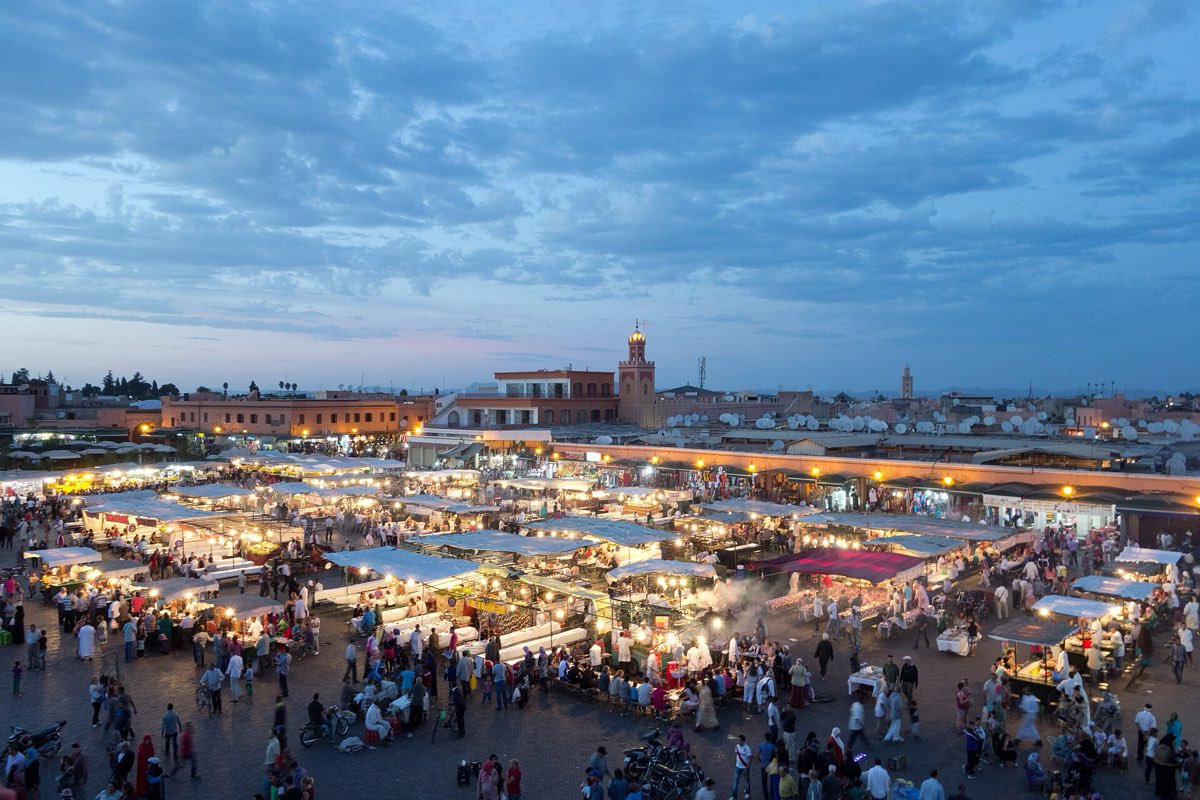
Jemaa el-Fnaa square crowded with stalls and people
Jemaa el-Fnaa

Jemaa el-Fnaa & the souks ساحة جامع الفنا

UNESCO Masterpiece of Oral Heritage, 2001

By day: orange-juice carts, henna artists and snake charmers. From late afternoon the food stalls set up in rows and the square fills with storytellers, Gnawa musicians and crowds. The souks to the north are organised by trade: dyers, metalworkers, leather, spices, lamps.

  • This square inspired UNESCO's whole idea of protecting "intangible heritage". The Spanish writer Juan Goytisolo, who lived nearby, campaigned to save it from development, and it was among the first places proclaimed in 2001.
  • Watch the square from a rooftop café at sunset. Anyone who poses for your photo (snake charmers, monkey handlers, costumed water sellers) will ask for a tip. Agree to the price first, or skip it.

If you have free time

  • Jardin Majorelle & YSL Museum: the cobalt-blue garden that Yves Saint Laurent saved. Book a timed ticket online in advance.
  • Ben Youssef Madrasa: the largest madrasa in Morocco, built in the same tile-stucco-cedar style as the ones in Fes.
  • Le Jardin Secret: a restored medina palace garden, a calm escape from the souks.
  • Taxis: insist on the meter or agree on the price before getting in. The small red petits taxis are the city ones.
8
Saturday 7 November

Bslama, Morocco

Transfer to Marrakech Menara airport~15–20 min from the medina

Leave 2–3 hours before your flight. Dirhams can't legally be taken out of Morocco, so spend or change them before security. Keep your currency exchange receipts if you want to change money back at the airport.

Context

1,200 years of dynasties, in the order you'll meet them

Almost every monument on this trip was built by one of six dynasties. Knowing which one helps you read the buildings.

  1. 789–974

    Idrisids

    First Islamic Moroccan state. Founded Fes.

    See: Fes el-Bali, Al-Qarawiyyin (859)
  2. 1040–1147

    Almoravids

    Amazigh warriors from the Sahara who ruled from Spain to Senegal.

    See: Marrakech (founded c. 1070)
  3. 1147–1269

    Almohads

    The great builders of minarets and city walls.

    See: Koutoubia, Hassan Tower, Udayas
  4. 1244–1465

    Marinids

    Ruled from Fes and filled it with madrasas.

    See: Bou Inania, Al-Attarine, Fes el-Jdid
  5. 1549–1659

    Saadians

    Grew rich on sugar and the gold of Timbuktu.

    Optional in Marrakech: Saadian Tombs
  6. 1631–today

    Alaouites

    The current royal family, originally from the Tafilalt oasis.

    See: Tafilalt (Day 2–4), Mausoleum, royal palaces
  7. 1912–1956

    French protectorate

    Built the roads, Ifrane, Ouarzazate and the new towns outside the medinas.

    See: Tichka road, Ifrane, Casablanca
  8. 1956 → 1993

    Independence

    Mohammed V returns from exile. Hassan II rules 1961–1999.

    See: Mausoleum, Hassan II Mosque
Practical

Good to know

Weather in early November

PlaceDayNight
Marrakech24 °C11 °C
Tichka pass10 °C0 °C
Ouarzazate22 °C8 °C
Merzouga25 °C8 °C
Ifrane15 °C3 °C
Fes22 °C10 °C

Typical averages. Pack layers, a warm jacket for the desert night and sunglasses for the dunes.

Money, time & plugs

  • Currency: Moroccan dirham (MAD), around 10–11 to the euro. It's a closed currency, so get it from ATMs on arrival.
  • Cash: needed for tips, small shops and the desert. Cards work in hotels and bigger shops.
  • Tipping: 10–20 MAD for small services, around 10 % in restaurants. Tip your driver and guides at the end.
  • Time: GMT+1, one hour behind Sofia.
  • Plugs: type C/E, 220 V, the same as at home.
  • Dress: shoulders and knees covered in medinas and mosques.

A few words of Darija

Hello السلام عليكم
Thank you شكرا
No, thank you (you'll use this a lot) لا، شكرا
How much? بشحال؟
Too expensive غالي بزاف
Good مزيان
OK / enough صافي
God willing إن شاء الله
Goodbye بسلامة
Hello in Tamazight (Berber) ⴰⵣⵓⵍ

Tap a phrase to hear it. Synthetic Arabic voice; Moroccan Darija sounds a little different.